The secret to being a successful indoor cricket bowler? No, it's not Testosterone . . .
Despite all the hype, the main aim of a good indoor cricket bowler is not knocking the batsman's head off or breaking his / her ribs. It's actually a little more nuanced than that . . .although it should be noted, what makes a "good ball" against one batsman doesn't mean it's going to be the best choice against another.
* BATTING * BOWLING * FIELDING * THROWING * WICKETKEEPING *
Bowling
The basic strategy when bowling is to prevent the batswoman from scoring. Failing that, it is to stop her from scoring 2's. Of course, if you're defending a very low score, the main aim becomes the taking of wickets, but restricting scoring is the back-up even then.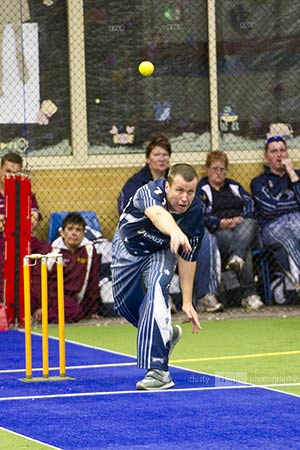
To prevent the batswoman from scoring, or from
scoring 2's, the bowler should be bowling within that old maxim,
"line and length", although it's slightly different from outdoor
cricket. The line (direction of the delivery) and length should
be such that the batswoman doesn't have the room to play the
standard "down and up" shot so successful in indoor cricket (see
above). The better bowlers try to at least hit the batswoman on
the leading leg, at or a little above knee-height. This makes it
almost impossible to play down and up to the off side, and very
difficult and risky to try to play the same shot to the on side.
It also make the ball very difficult to drive firmly. Quicker
bowlers, or those who move the ball off the pitch, would be
aiming to hit the batswoman's leading leg a bit higher, more
around the hip, or, if they can get a bit of kick off the pitch,
up above the hip around the lower ribs.
The result of such a ball is very often a ball
played not too firmly to one of the in-close fielders. This in
turn greatly increases the chances of a run-out, either as a
result of the fielder tapping the ball straight back to the
wicketkeeper, or taking it and throwing to the other end
(remember, most batswomen will run whenever there is contact
with the ball, so the chance of run-outs in this fashion can
come around very frequently - if the bowler is doing the right
thing).
By bowling this line, even an over-pitched ball
becomes less damaging to the fielding side. An over-pitched ball
in line with the front leg will almost certainly be driven to
the ON side. The very worst result would be 4 scored. But if it
is lofted at all, it becomes a chance for one of the back-half
fielders to catch. On the other hand, an over-pitched ball on or
just outside OFF stump stands far more chance of being hit directly
to the back net, for a total score of 7, and no chance of being
caught (hits direct to the back net are not out if caught off
the net), whereas an over-pitched ball on or just outside LEG
stump has less chance of being hit directly to the back net and
more chance of being hit off the side net and caught.
The most common mistaken belief about bowling in
indoor cricket, especially from Testosterone-soaked young males,
is that faster is better. Well, if you are genuinely quick (and
that means very, very, very quick), your pace alone can
be enough to get you results. But for 99.999% of those who play,
line and length are paramount.
Bowlers of spin, leg-spin in particular, will sometimes bowl a different line to the above, especially if they believe they can get a particular batswoman out stumped or caught. But they too are generally best served by trying to hit the batswoman on or around the knee of the leading leg.